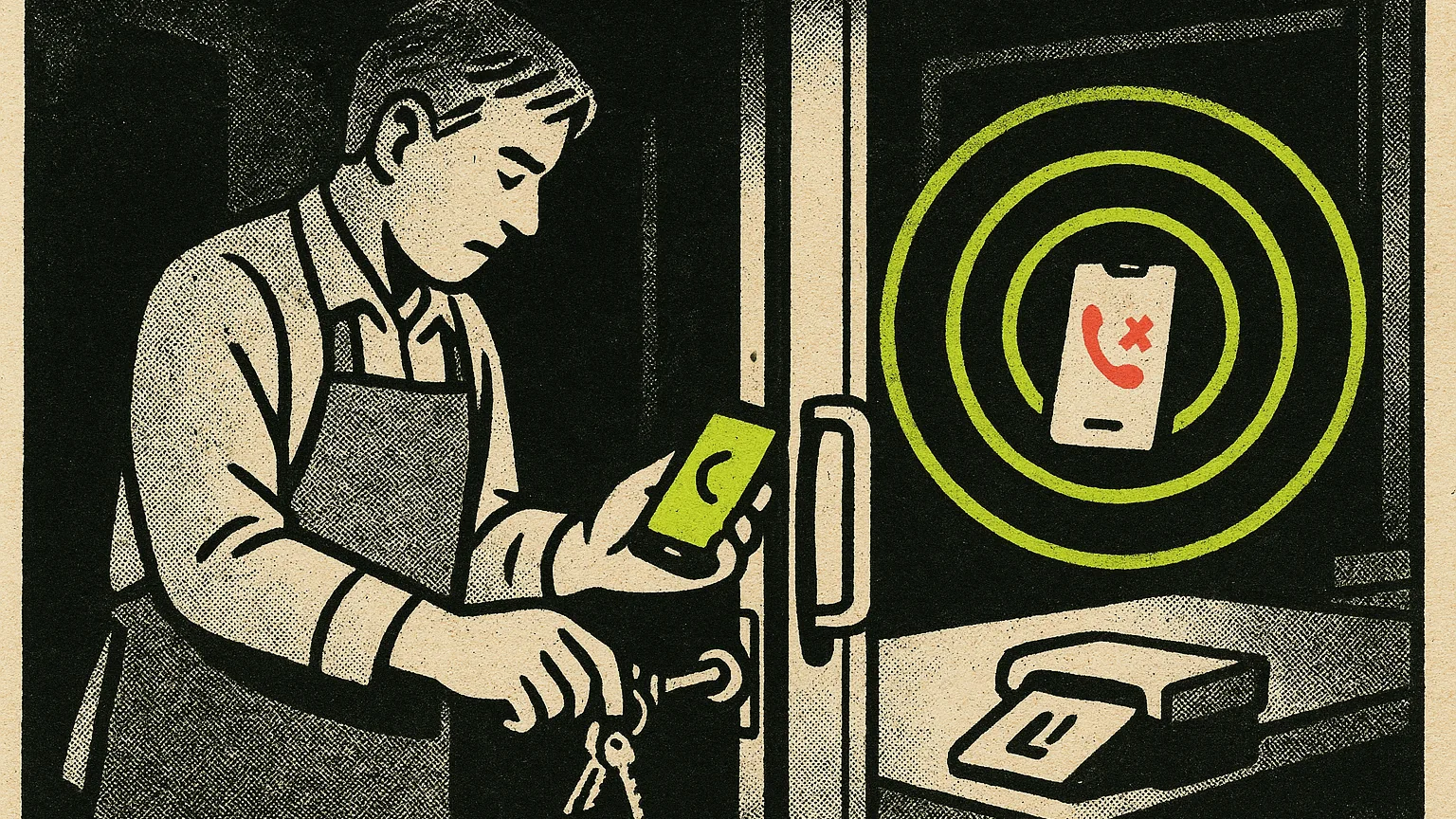
Some of the calls you miss after 6pm cost you nothing: the caller leaves a message, texts, or tries again in the morning. The expensive misses are the ones who don't. They call the next name on the list and never come back. An after-hours call answering service exists to catch those calls before they become someone else's job, but buying one only makes sense when the math says so. Count how many calls you're actually missing in a month. Put a real number on what a booked job is worth. Then ask how many of those callers would have tried you again. If what's left is bigger than the monthly bill, coverage pays for itself. If it isn't, skip it, and the rest of this note works through both directions.
What happens to a call after hours, really?
Nobody on your side picks it up. Depending on how your phone is set up, it rings out, drops to voicemail, or hits a generic greeting. Nobody looks at what kind of call it was, so an emergency and a wrong number get the identical dead end. What happens next is entirely up to the caller, not you.
Some callers leave a message and wait for you to call back in the morning. Some hang up and call the next name on the list instead. Nobody on your side knows which kind of caller hung up until the morning, if then. How the split runs for your shop is yours to estimate from your own callers. No vendor's number is a substitute.
That's the actual problem an after-hours answering service is sold to solve. Not "you missed a call," but "you don't know what you missed."
What's a missed call actually worth to you?
It depends entirely on what kind of call it is and what you do. A call that turns into a booked job at your average ticket price is worth real money; a call that would have gone nowhere anyway is worth nothing. The honest number is different for every shop, and it's yours to work out, not a vendor's.
For some businesses, a missed call after hours is closer to an emergency, one that closes that same night at a large ticket if somebody picks up. For others it's a routine booking that will still be there tomorrow morning, worth the same either way. Those two calls are not the same problem, and no flat answer covers both.
For a small business specifically, one owner, maybe a helper, nobody sitting at a front desk, this isn't an abstract question. You're the receptionist too, whenever you're free to be. Searching for an after-hours answering service for small business owners turns up plenty of vendors who'll tell you the answer is obviously yes. It isn't obvious. It's arithmetic, specific to your call volume and your ticket size, not theirs.
What does after-hours call answering service coverage actually cost?
Coverage is priced three ways: per minute, per call, or a flat monthly rate with a ceiling on calls or minutes. None of the three is inherently cheaper. It depends on whether your calls run long or short, and how many land outside business hours in a normal month.
Comparing the sticker price across vendors is close to useless without knowing which billing model each one is quoting. Two plans that look identical on the homepage can land in completely different places once your actual call pattern runs through them. A shop with short, infrequent calls does well on a per-minute plan and badly on a flat rate sized for higher volume. A shop with long or frequent calls is usually the reverse. The only way to know which you are is to run your own numbers, not the vendor's example customer.
Where's the break-even?
Coverage is worth its price only when the revenue it protects is bigger than the bill. Multiply your missed calls a month by your average job value, subtract the share of callers who'd have tried you again anyway, and compare what's left to the monthly cost of coverage.
Here's the arithmetic, worked through once. Say you miss ten calls a month after 6pm. Your average booked job runs $250. Say, from what you know of your own customers, that a third of those callers try you again the next morning and the other two-thirds move on for good. That's roughly $1,667 a month walking away: ten calls, two-thirds of them gone, $250 each. If a coverage plan costs less than that, it can pay for itself. If it costs more, it can't, no matter how good the service answering the phone actually is.
The same math at other volumes and ticket sizes:
| Missed calls/month | Average job value | Share lost for good | Revenue at risk/month |
|---|---|---|---|
| 5 | $150 | 2/3 | $500 |
| 10 | $250 | 2/3 | $1,667 |
| 20 | $500 | 1/2 | $5,000 |
| 30 | $900 | 1/2 | $13,500 |
Coverage is worth buying below the number in the right-hand column for your row. Above it, you're paying more to catch a call than the call is worth. That's a real number, not a marketing one, and it's the only one that should decide this.
Don't buy this if…
Skip after-hours coverage if you're missing only a handful of calls a month, if most of what you miss is routine rather than time-sensitive, or if your average job value is low enough that catching every single missed call still wouldn't cover the bill. The table above tells you which one you are.
Skip it, too, if you're the kind of shop where a caller who gets no answer calls back tomorrow anyway. Paying to catch a call that was never actually at risk of leaving is money spent solving a problem you don't have.
If none of the arithmetic adds up to real money yet, a plain text-back that fires the moment you miss a call is worth trying first. It won't have a conversation or triage anything, but it costs a fraction of full coverage and catches a fair share of the callers who wanted to know you saw them. If that's enough, you're done.
You don't need to buy more than the problem you actually have.
Is "after-hours answering services" the same search?
Yes. It's the same category under the plural phrasing: the same vendors, the same billing models, the same math. Search interest in the plural version has been falling as buyers converge on the singular phrase, but nothing about what you're evaluating changes with the wording.
What does change the arithmetic is the trade you're in and the kind of call you're missing. A same-night emergency, a bid with a deadline, a routine rebooking: each one changes what a missed call is worth and what coverage is worth paying for. Work out which kind of call you actually miss before you shop, not after.
Sources
- Simple Answering Service Pricing | Rates From $44 per Month — Specialty Answering Service, accessed 2026-09-07
- Smith.ai Plans & Pricing for 24/7 Sales & Support — Smith.ai, accessed 2026-09-07
- Ruby Receptionist Pricing: Scalable Virtual Support — Ruby Receptionists, accessed 2026-09-07