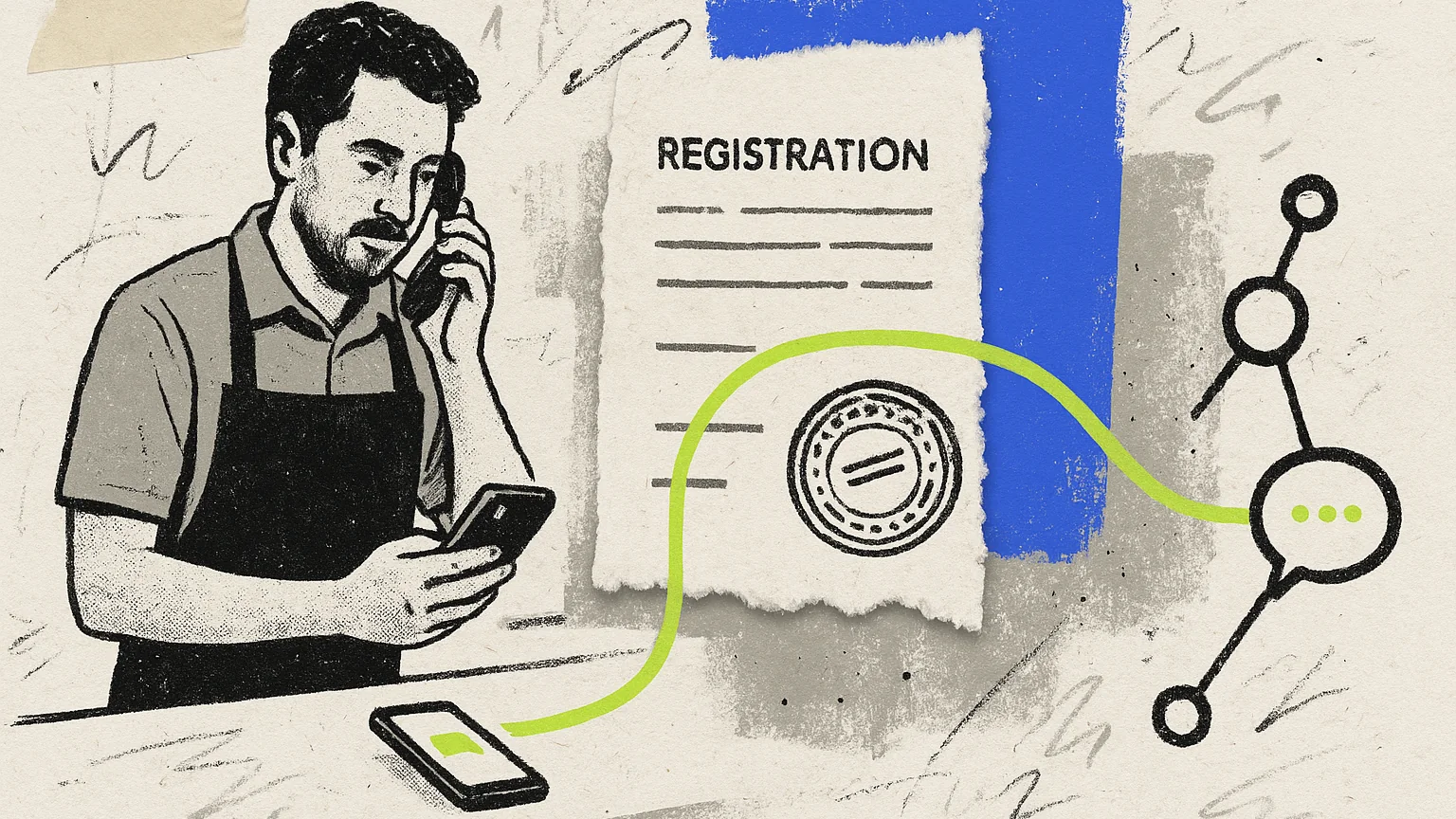
10DLC, short for 10-digit long code, is the registration system that decides whether a text message sent from a business's ordinary local number actually reaches its recipient. AT&T, T-Mobile and Verizon require a business sending automated texts to register a brand and a campaign with The Campaign Registry, the shared industry clearinghouse built for this, before they'll deliver that traffic reliably. If your shop recently turned on missed-call text-back, the reply it fires out travels over exactly this kind of number, and it depends on that registration already being done, whether your phone system handled it, your scheduling app handled it, or nobody did. Skip it, and the texts don't bounce back with an error. They quietly stop arriving on some carriers' networks, which looks identical to the text-back working.
What is 10DLC, and why does it affect your business's text messages?
10DLC is the framework AT&T, T-Mobile and Verizon use, through The Campaign Registry, to vet and register text messages sent from an ordinary 10-digit business number, as opposed to a short code. If your line isn't registered under it, the texts it sends can be filtered, delayed, or blocked by carrier networks instead of delivered.
The rule exists because a normal-looking phone number sending automated texts is exactly what spam and scam traffic looks like too. AT&T, T-Mobile and Verizon needed a way to tell "a real shop's text-back" from "a mass-texting operation hiding behind a regular number," and the answer they settled on was routing every business's registration through The Campaign Registry: identify the business, declare what the messages are for, and get vetted before the traffic is trusted at scale.
That's the whole idea. It's not a tax on small business texting so much as the price of the carriers no longer treating every 10-digit number as a private citizen's phone.
What does 10DLC registration actually cost?
A one-time fee to register the business as a brand, plus a smaller recurring fee for each campaign registered under it. Both amounts move with the vetting tier chosen, and most trade businesses fall into the cheapest tier available for a low-volume, single-purpose use case like a text-back reply.
That's the shape of the bill, not the number on it. Prices in this system are set by the registry and the carriers, not by whichever software vendor is selling you the text-back feature, so the honest way to check your own cost is the invoice from whoever runs your texting, not a blog post's guess at a figure that changes.
How long does 10DLC registration take?
It depends entirely on which vetting tier the campaign is registered under. A basic registration can clear in a day or two; a tier that requires more identity verification can take closer to two weeks, and a rejected submission restarts the clock from the beginning.
That range matters more than the average, because the businesses most likely to hit the slow end are the ones with a newer entity, a sole-proprietor setup, or a business name that doesn't quite match what's on file with the state. None of that is disqualifying. It just means starting the process before you need it working, not after a customer already didn't get a reply.
What happens to text messages sent without 10DLC registration?
They don't bounce back with an error. Carriers filter, delay, or silently drop unregistered traffic instead, which means a text-back can look like it's working on your end while never reaching a real number of the customers it was sent to.
That silence is the trap. A failed phone call is obvious. A dropped text looks, from the sending side, exactly like a delivered one: no error, no bounce, no notification that anything went wrong. The only way most shops find out is a customer mentioning they never got the reply, by which point it's already cost a few callbacks nobody can count.
Here's what that comparison looks like against the two other ways a business number can send texts:
| Number type | Registration path | Typical throughput | Approval timeline shape | Best fit |
|---|---|---|---|---|
| 10DLC long code | Brand and campaign registered with the shared industry registry | Limited per number, tiered by vetting level | Same-day to about two weeks, depending on the tier | A shop already texting from its normal business number |
| Toll-free number | Verified directly with the carriers, no campaign registry involved | Higher once verified | Its own separate review queue, historically slower during high-volume stretches | A shop sending higher SMS volume from a dedicated line |
| Short code | Leased and vetted through a single vendor; the most expensive path | Highest of the three | A longer, multi-week carrier review | High-volume marketing texting, not a typical trade shop's text-back |
Most shops running a text-back off their existing number are squarely in the first row. The other two exist, and knowing they exist is enough to recognize when a vendor's pitch is quietly describing one of them instead.
Why does the missed-call text-back you turned on depend on this?
Because that reply travels over your business's regular long code number, the exact kind of number 10DLC governs. Whoever sold you the text-back feature is supposed to have registered it, under their own brand or yours, but that step is invisible from your side unless you go looking for it.
A missed-call text-back is sold as the cheapest fix in this whole category, something you can turn on in an afternoon. That's true of the feature. It's not true of what has to be working underneath it for the feature to mean anything, and registration is the part of "underneath it" that a pricing page has no reason to mention.
Don't buy this if…
Skip chasing this yourself if your phone system or answering service already bundles registration into the product. Check the invoice for a line item, or ask directly whether your number and campaign are registered, before assuming the work hasn't been done.
Skip it entirely if you never send an outbound text from your own business number in the first place. A service that answers with a live person and never fires an automated text back has nothing running over a 10DLC number to register. This is a problem that only exists once a text starts going out automatically in your business's name.