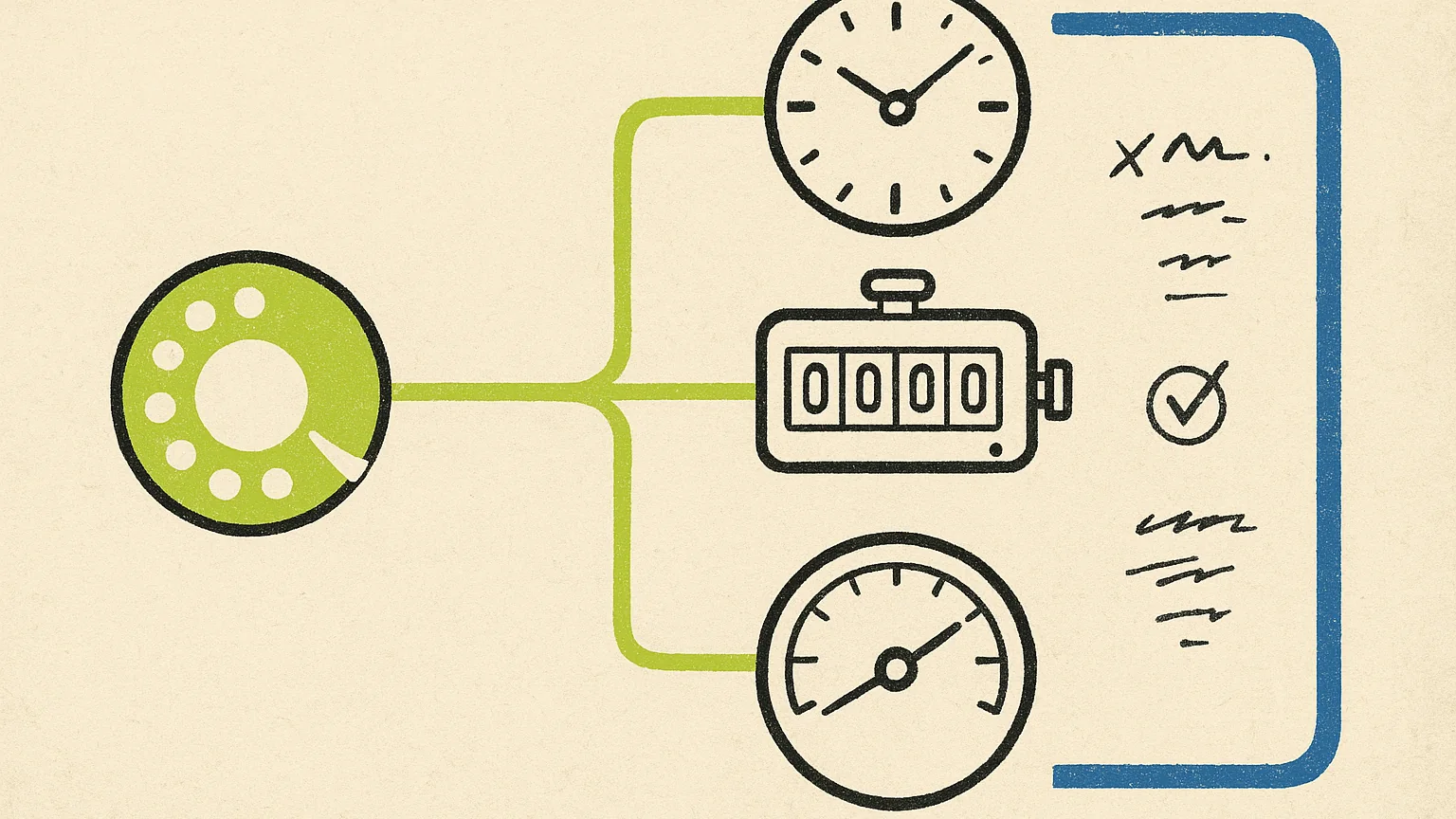
Answering service cost depends less on the vendor than on which of three billing models your quote sits on: per minute, per call, or flat rate with a call ceiling. The same call volume can cost you wildly different amounts depending on which model you're on, because each one charges for a different thing. A per-minute plan bills for how long your calls run. A per-call plan bills for how many calls come in, no matter the length. A flat-rate plan bills a fixed amount up to a ceiling, then charges extra past it. Match the model to your own call pattern and the price gets predictable. Get the match wrong and the same coverage costs more than it should.
What actually decides your answering service cost?
Not the vendor, and not the sticker price on the homepage. It's the billing model underneath it. Nearly every provider prices coverage one of three ways: per minute, per call, or flat rate with a ceiling, usually on calls, sometimes on minutes. The same call volume costs three different amounts depending on which model it's billed under, so the model matters more than the brand.
Some national providers post their prices in the open (these are as of September 2026). AnswerFirst lists a $30 monthly base plus $1.60 to $1.95 a minute. NextPhone (getnextphone.com) lists a flat $199 a month with unlimited calls. Nextiva lists its XBert AI receptionist at $99 a month for 100 conversations, calls, texts or chats, then $0.99 each. Housecall Pro sells call answering too, but its pages ask you to book a demo rather than posting a rate. A posted price is useful, and it's also incomplete. It tells you what a plan costs. It doesn't tell you which model fits calls like yours, and that part depends on you, not on the page.
What does a per-minute plan actually charge you for?
Time on the phone, plain and simple. Every second the person or system spends on your call gets billed, whether the caller booked a job in ninety seconds or worked through a slow intake for six minutes. Hold time and callbacks usually count too, which is where the bill quietly grows.
The pitch is predictability: you know the rate, so you can estimate the bill. The catch is that the estimate only holds if your calls are actually short. A per-minute plan suits calls that are brief and don't vary much in length. It punishes the opposite hardest: long, complicated, or repeat-contact calls.
What does a per-call plan actually charge you for?
The call itself, not its length. Whether it runs twenty seconds or twenty minutes, a per-call plan, sometimes marketed as pay-per-call, charges the same fee. That flips the risk: length stops costing you extra, and count becomes the thing that drives the bill instead.
This model suits a business with short, high-volume calls, where paying by the minute would add up fast. It's a worse deal if a meaningful share of your inbound is wrong numbers, spam, or the same caller trying three times in a row, because a per-call plan bills all of those at full price too.
What does a flat-rate plan actually charge you for?
A ceiling, not a total. You pay one fixed amount for calls up to a set number each month, and once you cross it the plan either bills an overage rate per call or bumps you to the next tier. The flat number is the floor of your bill, not the whole of it.
Flat rate suits volume that's seasonal or growing, where a predictable budget line matters more than shaving the last dollar. It's the wrong fit if your volume is consistently low, because you're then paying for headroom you rarely use. It's also the wrong fit if a spike routinely blows past the ceiling, because the overage rate is often steeper than the base plan implied.
How do you tell which model is cheaper for your shop?
Run your own call count and average call length through all three models, not the one the salesperson leads with. The cheapest model on a vendor's homepage is the one that's cheapest for their average customer, not necessarily for you, and the only way to know is to do the arithmetic on your own numbers.
Here's the arithmetic, worked through once. Say a vendor quotes you the same coverage three ways: 90 cents a minute, $1.50 a call, or $180 flat for up to 150 calls with $1.20 per call after that. Those are example numbers to plug your own quote into, not published rates. Run three months of different volume against them and the winner moves:
| Month | Calls | Avg. length | Per-minute bill | Per-call bill | Flat-rate bill |
|---|---|---|---|---|---|
| Slow | 60 | 2 min | $108 | $90 | $180 |
| Typical | 120 | 3 min | $324 | $180 | $180 |
| Busy | 200 | 4 min | $720 | $300 | $240 ($180 + 50 over x $1.20) |
In a slow month, per-call wins. In a busy month with long calls, flat rate wins by a wide margin, and per-minute is the expensive choice in every row here because these calls run long. Swap in your own quote's numbers and your own typical month, and the table tells you which column you're actually in, not which one a vendor's homepage led with.
Is AI receptionist pricing different?
Not structurally. It's billed the same three ways. What's different is the marketing: AI receptionist pages lean harder on the flat-rate and "unlimited" story, because the software's own cost per call is close to zero for the vendor, and that framing is what's growing fastest right now.
"Unlimited" is worth reading closely before you count on it. Some plans mean it literally: NextPhone's pricing page says "Truly unlimited calls at one flat rate," and its terms of service, as of this writing, put no number on call volume. Others keep a fair-use clause in reserve: HighLevel's AI Employee Unlimited plan, $97 a month per location, lists "Unlimited Voice AI" and then says that if usage is "excessive" it may "throttle, limit, require service upgrades, or terminate access." And some say unlimited while metering something else: Nextiva's XBert page says "Answer unlimited calls 24/7" on the same card that bills $99 a month per 100 interactions and $0.99 for each one after, which is the flat-rate tier above under another name. Ask the same question you'd ask a flat-rate plan: what happens on the month you go over, and what does that actually cost.
When should you skip this and do something cheaper first?
Don't buy this if your after-hours or overflow volume is small enough that any plan's minimum fee costs more than the calls it catches are worth. The after-hours note shows how to put a number on that. A plain missed-call text-back solves a real slice of the same problem for a fraction of the price, and it's worth trying first.
It's also a bad trade if you can't yet say, roughly, how many calls a month you're actually trying to cover. Guessing at volume before you buy is how shops end up on the wrong model and pay for it for a year. Count first. Buy second.
That's the whole decision: pick the model that matches your calls, not the one at the top of the pricing page. If you want a second opinion on a specific quote, the contact page is there, but most people who've run the table above won't need one.
Sources
- Answering Service Pricing | Different, Better Pricing | AnswerFirst — AnswerFirst, accessed 2026-09-07
- #1 Pre-Paid Answering Service | AnswerAmerica — AnswerAmerica, accessed 2026-09-07
- Smith.ai Plans & Pricing for 24/7 Sales & Support — Smith.ai, accessed 2026-09-07
- AI Receptionist Pricing - 7-Day Free Trial | NextPhone — NextPhone, accessed 2026-09-07
- XBert AI Receptionist Software - Answer Every Call 24/7 — Nextiva, accessed 2026-09-07
- Best 24/7 Call Answering Service for Home Service Businesses — Housecall Pro, accessed 2026-09-07
- Terms of Service — NextPhone, 2026-08-14
- HighLevel AI Products Pricing: Voice AI, Agent Studio & More — HighLevel Support Portal, 2026-09-02