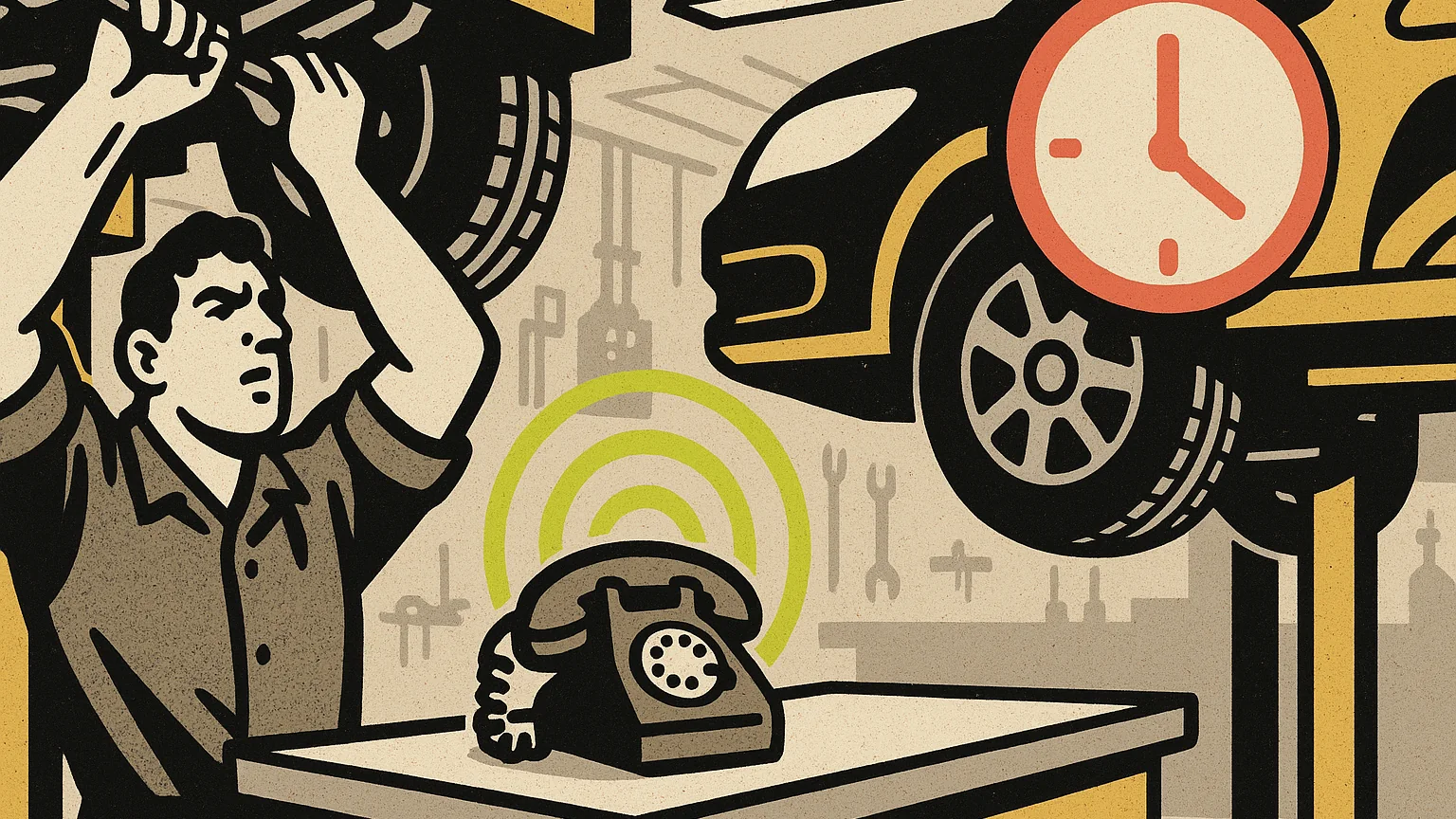
An automotive answering service earns its cost differently than the emergency trades on this site, because the calls it needs to catch aren't midnight crises. They're daytime calls that happen while every tech has both hands inside an engine bay: a customer asking if the car is ready, an estimate approval that's holding a bay hostage until someone says yes, and a tow-in arriving at the door with nobody free to log it in. None of that is urgent the way a burst pipe is. It's small money, lost in small amounts, all day, every time one of those calls goes to voicemail instead of a live answer.
What makes an automotive answering service different from an emergency-trade answering service?
It isn't urgency. Every emergency trade on this site — plumbing, HVAC, towing — earns its coverage from a call that can't wait. A shop's problem is different: the person who could answer is under a lift with both hands busy, and most of what gets missed isn't an emergency at all.
The general after-hours math starts from what a missed call after 6pm is worth, and for the emergency trades that number is large because the call is a genuine crisis. A repair shop's missed calls mostly happen at 10am, not midnight, and most of them are routine — they just land while every tech's hands are full.
That's not a smaller version of the same problem. It's a different one, and coverage built for the midnight crisis doesn't automatically solve it.
What kind of calls actually cost a shop money when nobody answers?
Three kinds, and none of them is a crisis. A customer checking if the car is ready. A customer approving an estimate that's holding a bay until they say yes. A tow-in arriving with nobody at the counter to receive it. Small amounts, all day, not one large ticket.
Each one is ordinary on its own. A customer who wants a status update. A driver approving another $400 of work found mid-teardown. A tow truck pulling in with a car nobody scheduled. None of them sounds like the reason to buy coverage, until you count how often they happen in a week and multiply.
The pattern only shows up at volume, which is exactly why it's invisible from the counter. Nobody notices four short missed calls a day the way they'd notice one burst pipe at 2am.
How much does a stalled approval call actually cost the shop?
There's no universal number, but the arithmetic is simple: an idle bay costs whatever that bay bills per hour, prorated to however long the approval call sits unanswered. A 40-minute wait on a $150-an-hour bay is real money lost before the phone even reaches voicemail.
Here's the arithmetic, worked through once. Say a bay bills out at $150 an hour when it's moving — that's an example number to run your own shop's rate against, not a published average. Each row below assumes the same rate and shows what changes with how long the call sits.
| Call type | Why it isn't an emergency | What it actually costs when it's missed |
|---|---|---|
| "Is my car ready?" status check | The work continues either way; the customer's just planning their day | A callback later, and a customer who's already called around to see if anyone else can look at it |
| Estimate approval | Nothing dangerous is happening | The bay sits idle at whatever it bills per hour until someone says yes — 40 minutes on a $150/hr bay is roughly $100 of billable time nobody gets back |
| Unannounced tow-in | The car isn't any more broken for sitting a while | A driver waiting at the curb, or a car left with no one told it arrived |
That middle row is the one that compounds. A shop that lets three or four estimate calls a week sit for 40 minutes apiece has quietly given up something close to a full bay-hour of billable time to calls nobody was in a position to take.
What should an automotive answering service actually be able to do that a generic one can't?
See enough of the shop's own system to answer "is it ready" with real status, not a guess. Reach whoever can approve an estimate on the spot, not leave it in a queue. And be reachable enough that a tow driver dropping off a car unannounced has somewhere to go.
A script built for message-taking treats all three of those calls the same way: take a name and number, promise a callback. That's not wrong, exactly. It's just not what any of the three calls above actually needed, and the shop pays for the gap in idle bay-time and a customer calling around.
What it actually needs is closer to visibility than sympathy: real status on the repair order, a live route to whoever can say yes to an estimate, and someone who can receive a car at the door. That's a different product than coverage built to sound reassuring at 2am, and most vendor pages selling "24/7 auto answering" don't say which one you're getting.
Don't buy this if…
Skip it if someone already sits at your front counter full time during business hours and picks up reliably; the problem this solves doesn't exist for you yet. Skip it too if most of what you miss really is after-hours, not daytime; that's the after-hours question, not this one.
Most shop owners already know their own front-counter coverage better than any vendor's pitch does. If nobody's complained about reaching you and no bay has sat idle waiting on a callback, coverage priced for this exact problem isn't solving one you have.