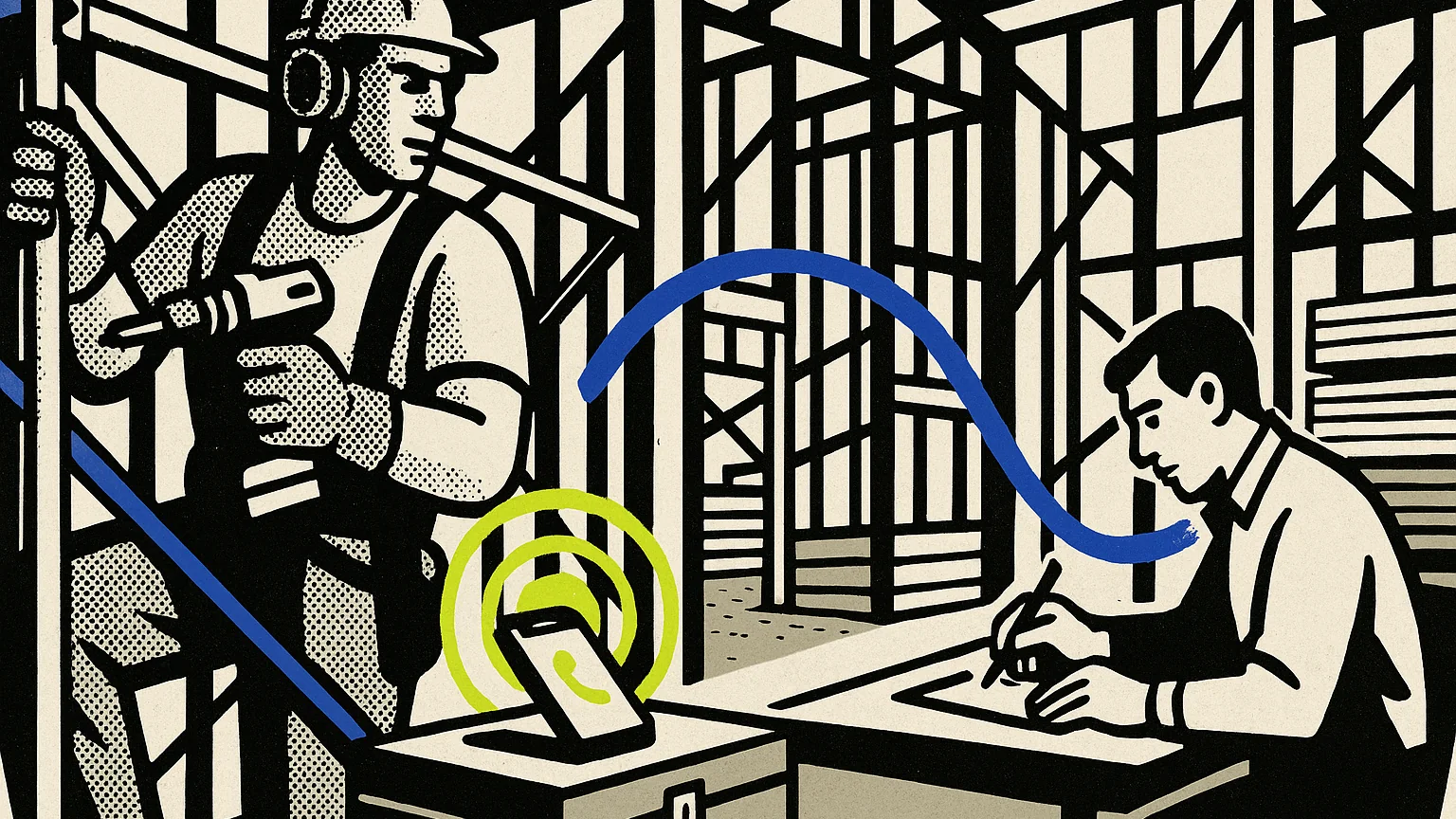
A construction answering service solves a different problem than most after-hours coverage. The gap it closes isn't nighttime, it's the middle of a normal workday: you're on a ladder, running a saw, or forty feet up on scaffolding with gloves on, and the phone in your pocket might as well not exist. The call that matters most is rarely random. It's a subcontractor confirming today's start time, a supplier calling about a delivery window, or the office trying to reach you before a decision gets made without you. What a construction answering service needs to get right is routing that message to someone who can act on it before the job moves past the point an answer still matters, not triaging an emergency, because most days there isn't one.
What makes a construction answering service different from other after-hours coverage?
The vertical-specific story isn't urgency after dark, it's reachability during the day. A plumber's after-hours line exists because the emergency happens at 2am. A construction crew's problem happens at 10am, when the person who'd normally answer is on a ladder with gloves on and the phone is sitting on a toolbox twenty feet away.
The general after-hours math assumes the missed window is nights and weekends, when you've clocked out and could plausibly not be reachable. Construction inverts that. You're working the whole time the call comes in, but you're not reachable, which is a different failure than being unavailable, and it calls for a different fix: not someone to catch calls while you sleep, but someone to catch calls while your hands are full.
You already know this from any day on site. Nobody's phone rings less during a pour or a framing push. It rings the same as any other day. What changes is whether anyone can get to it.
What does a construction answering service actually need to get right?
Routing, not triage. A call that reaches the job site has to get to someone who can act on it, whether that's the office, a foreman with a radio, or you at lunch, before the crew moves past the point where an answer still changes anything. A voicemail nobody hears until 5pm might as well not exist.
That's a narrower job than what an emergency-trade service does. There's usually no burst pipe to sort from a routine call here. Instead there's a subcontractor callback chain to manage: a sub calling to confirm they're still on for tomorrow, a supplier confirming a delivery window, an inspector trying to schedule a walkthrough. None of it sounds urgent on a recording. All of it stops mattering if the answer arrives after the crew has already made the call themselves and guessed wrong.
Getting that handoff right means the service knows who to reach for what, beyond sounding alarmed. A message that reaches your phone at 6pm about a 9am delivery window did its job technically and failed it completely.
What does it cost when a job-site call gets missed?
Usually not a lost sale, since most construction inbound isn't a new lead. It's a schedule slip: a subcontractor who couldn't confirm today's start time, or a supplier whose delivery window nobody answered, either of which can idle a crew you're still paying for the day.
Here's the arithmetic, worked through once with example numbers to swap for your own, not a published rate. Multiply the crew-days you lose to unanswered coordination calls by what a day actually costs you in labor and equipment sitting idle:
| Missed job-site calls/week | Crew size | Day rate (labor + equipment) | Schedule slips this causes/month | Cost/month |
|---|---|---|---|---|
| 3 | 2 | $700 | 1 | $700 |
| 6 | 4 | $1,400 | 2 | $2,800 |
| 10 | 6 | $2,200 | 3 | $6,600 |
| 15 | 10 | $3,600 | 4 | $14,400 |
The day rate column is doing the real work here, not the call count. A missed call costs the same whether your crew is two people or ten. What it triggers doesn't. Run your own crew's day rate through this before you compare it to what coverage costs, because that number is the one no vendor's pricing page can tell you.
Where's the break-even for a construction business specifically?
It scales with crew size, not call volume. A missed coordination call that costs a two-person crew half a day is a few hundred dollars. The same missed call against a ten-person crew is thousands, which is why the honest math has to start from your own day rate, not a generic missed-call value.
That also means the break-even moves as you grow. A service that wasn't worth the cost when you ran a two-person crew can clear it easily once you're running three crews at once and can't personally field every coordination call yourself. Recheck the arithmetic when your crew size changes instead of assuming last year's answer still holds.
Don't buy this if…
Skip it if someone in your office already answers site-related calls reliably during business hours, if your subs coordinate mainly through a shared schedule app or text instead of phone calls, or if most of the calls you actually miss turn out to be minor logistics anyone on site could answer without you.
Skip it too if your jobs run small enough that a half-day slip barely registers against the schedule. The table above only earns its keep once a missed call has a real chance of idling a crew you're paying for, and a lot of small residential work doesn't carry that risk the way a multi-sub commercial job does.
If you're not sure which kind of job you mostly run, track a month of missed calls and sort them into "caused a delay" and "didn't." That's the honest input the table above needs, and it's a number worth having before any vendor quotes you a monthly rate.
Is a construction answering service the same as a contractor answering service?
No, even though the two pages sound alike. A contractor answering service is about catching a bid solicitation before its deadline, a chance at new work. A construction answering service is about staying reachable during an active job, so the work you already have doesn't stall waiting on an answer nobody gave.
The contractor page is the right read if your missed calls are mostly other GCs or property managers inviting you to price a job. This page is the right read if your missed calls are mostly the job you're already running trying to reach you. Some businesses need both. Most will recognize which problem is theirs from the first paragraph. If you want a second opinion on a specific quote, the contact page is there, but most crews that have sorted their own missed calls into "new work" or "current job" won't need one.
Sources
- Construction Statistics | Noise and Hearing Loss — NIOSH, Centers for Disease Control and Prevention, 2026-04-13
- Fall Protection - Overview — Occupational Safety and Health Administration, accessed 2026-09-07
- 1926.95 - Criteria for personal protective equipment — Occupational Safety and Health Administration, accessed 2026-09-07
- Don't Blame The Workers — Engineering News-Record, 2011-06-01
- Last Planner System — Lean Construction Institute, accessed 2026-09-07