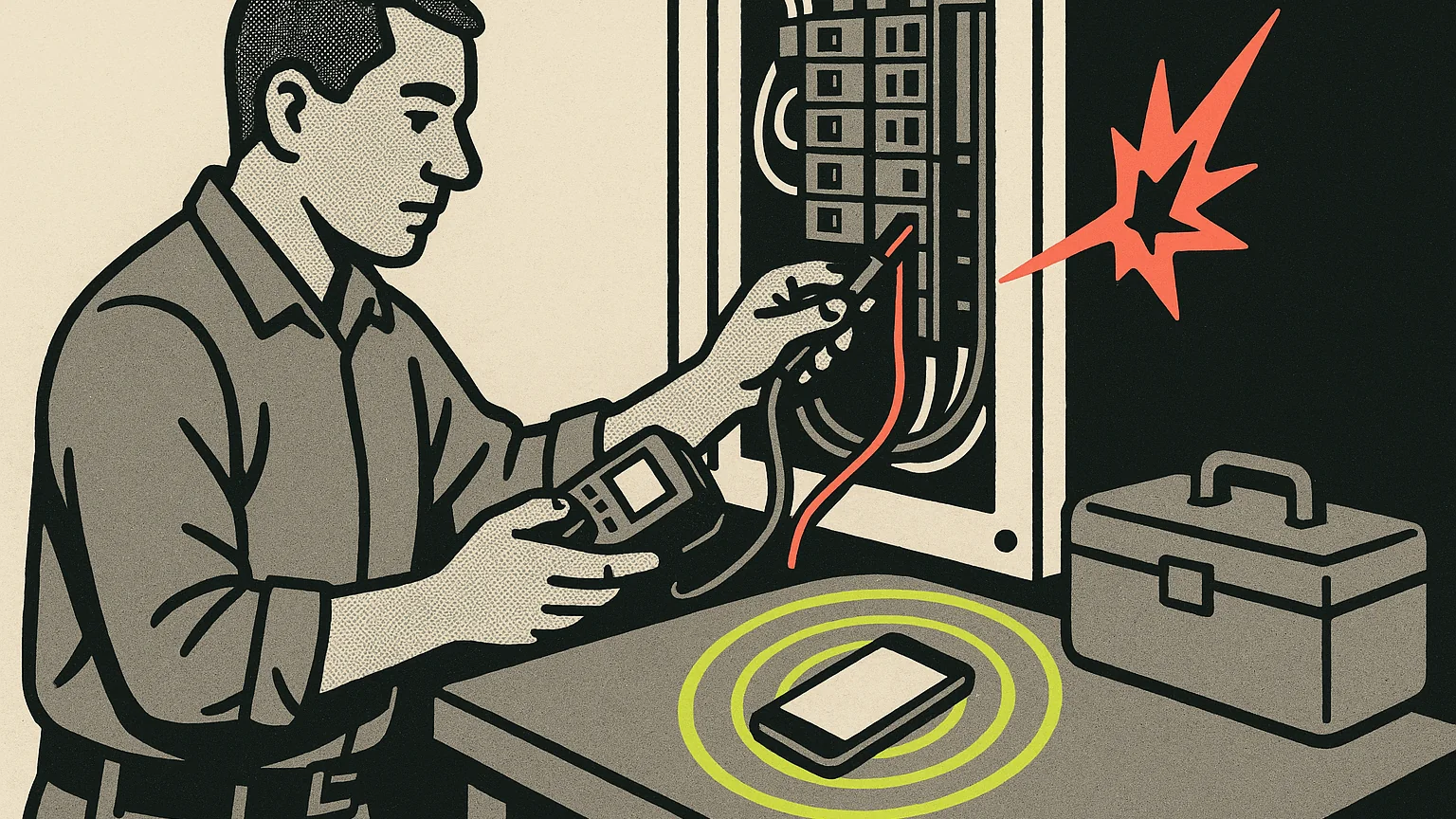
An electrician answering service has to sort two very different calls the instant the phone rings: "there's smoke coming out of the panel" and "I need an outlet added before Friday's inspection." The two calls need opposite handling, and the cost of mixing them up isn't symmetric. Treat a live hazard as routine and someone waits next to a burning smell for a callback that should have gone out immediately. Treat a routine job as urgent and you've pulled someone off a ladder for a request that could have waited until morning. No other trade on this site pairs a wrong triage call with consequences this serious, so the real question here isn't after-hours coverage in general. It's whether whatever answers your line can actually make that one call correctly.
What makes an electrician answering service different from other trades on this list?
The difference isn't volume or timing. It's the ceiling on what a wrong guess costs. A missed booking anywhere else on this site loses a job. A missed hazard call here can leave someone next to smoke, sparks, or a dead breaker with no idea whether help is actually coming.
The general after-hours math starts from what a missed call is worth in lost revenue. That's still true here, but it undersells the actual stakes, because it treats every missed call as the same kind of loss. A missed quote request costs you a job. A missed hazard call costs something a dollar figure doesn't fully capture, which is why this row isn't really about coverage economics at all. It's about whether the thing answering your line can tell the two calls apart.
What's the actual hazard-or-not split an answering service has to sort?
Two buckets, and almost nothing in between. One is active and dangerous right now: smoke, arcing, sparking, a breaker that won't reset and is warm to the touch, or a power outage hitting someone on home medical equipment. The other is everything else: new work, repairs that can wait, inspections, estimates.
Most calls sort cleanly into one bucket the moment the caller finishes a sentence. A few don't, and those are the ones a triage system actually has to be built for, not the obvious ones on either end.
| What the caller says | Bucket | What has to happen next |
|---|---|---|
| "I smell something burning near the panel" | Hazard | Route immediately, no queue, no callback promise |
| "There are sparks when I plug something in" | Hazard | Route immediately, treat as active |
| "The power's out and my mother's on oxygen at home" | Hazard | Route immediately: the equipment, not the outage, is the emergency |
| "A breaker keeps tripping, no smell, no sparks" | Ambiguous | One follow-up question before deciding, not a guess |
| "I need an outlet added before an inspection Friday" | Routine | Schedule normally, no page |
| "Can I get a quote for a panel upgrade?" | Routine | Schedule normally, no page |
That middle row is the one worth watching. A service that only pattern-matches on words like "smoke" or "sparks" will sail past the outage call and the tripping-breaker call, because neither one contains a hazard word on its own.
Can a non-technical answering service actually make that call?
Only if it's built to ask the right follow-up question, not just to transcribe words. A script-based or AI service can catch "smoke" and "sparks" as hazard flags. It's much shakier on an outage-plus-medical-equipment call, where the hazard is in what the caller doesn't think to mention.
That's the gap worth checking before you buy: not whether a vendor's demo handles the obvious hazard call, because every vendor's demo handles the obvious hazard call. What you want to see is whether it asks a follow-up on the ambiguous ones, questions like "is anyone in the home relying on powered medical equipment" or "is the breaker warm to the touch," instead of defaulting either call straight to voicemail or straight to a page.
What does it cost when the triage goes wrong in either direction?
Two different costs, and neither is symmetric with the other. Miscall a hazard as routine and the caller is left waiting on a callback while the danger keeps developing. Miscall a routine job as urgent and you've dispatched or paged someone for a request with nothing time-sensitive about it at all.
The first failure is the one that matters more, and it's also the harder one to catch after the fact: a caller who gave up and called someone else, or worse, didn't call anyone at all, doesn't show up anywhere in your numbers. The second failure at least shows up on a bill or a burned-out on-call rotation. Neither failure is acceptable often, but only one of them is invisible until it isn't.
What should you ask a vendor, since there's no pricing benchmark to check them against?
Ask what happens on a call the script doesn't recognize, not what the monthly rate is. There's no reliable price benchmark for this term yet, so the number on a quote tells you less than a straight answer to one question: what does the service do when it isn't sure?
What the pricing page doesn't say is usually the answer. A vendor selling into a dozen trades at once is selling one script with trade names swapped in, and a generic script has no reason to know that a tripped breaker with no smell is different from one that's warm to the touch. Ask for the actual hazard checklist the service uses for electrical calls specifically, not the marketing language about "24/7 coverage." If they can't produce one, you've learned what you needed to know before signing anything.
Don't buy this if…
Skip it if you already carry a phone with you on every job and answer your own line, or if your after-hours volume is mostly routine scheduling rather than anything that could plausibly be a hazard. Coverage priced for emergencies you rarely get isn't protecting you from much.
Skip it too if you can't get a straight answer to the hazard-checklist question above. Coverage that can't reliably tell a burning smell from a request to move an outlet isn't a smaller version of what you need. It's a different product wearing the same price tag, and paying monthly for it doesn't lower your risk, it just moves the bill.
Sources
- Electrical Safety | Los Angeles Fire Department — Los Angeles Fire Department, accessed 2026-09-07
- Electrical Home Safety: Plug Into Safety — Fire Department of the City of New York, accessed 2026-09-07
- Home Safety - Electrical Safety Foundation International — Electrical Safety Foundation International, accessed 2026-09-07
- Power Outages | Ready.gov — Ready.gov, Federal Emergency Management Agency, 2026-06-04
- HHS emPOWER Program - About — U.S. Department of Health and Human Services, accessed 2026-09-07
- Medical Baseline Program | PG&E — Pacific Gas and Electric Company, accessed 2026-09-07
- Receptionist, powered by Jobber AI — Jobber Help Center, 2026-07-09
- AI Receptionist for Plumbing & HVAC: Emergency Triage, Dispatch & Booking — My AI Front Desk, 2026-08-04
- Couldn't Make It? Here's What You Missed About Maximizing Your AI Receptionist Webinar! — RingCentral Community, 2025-11-06