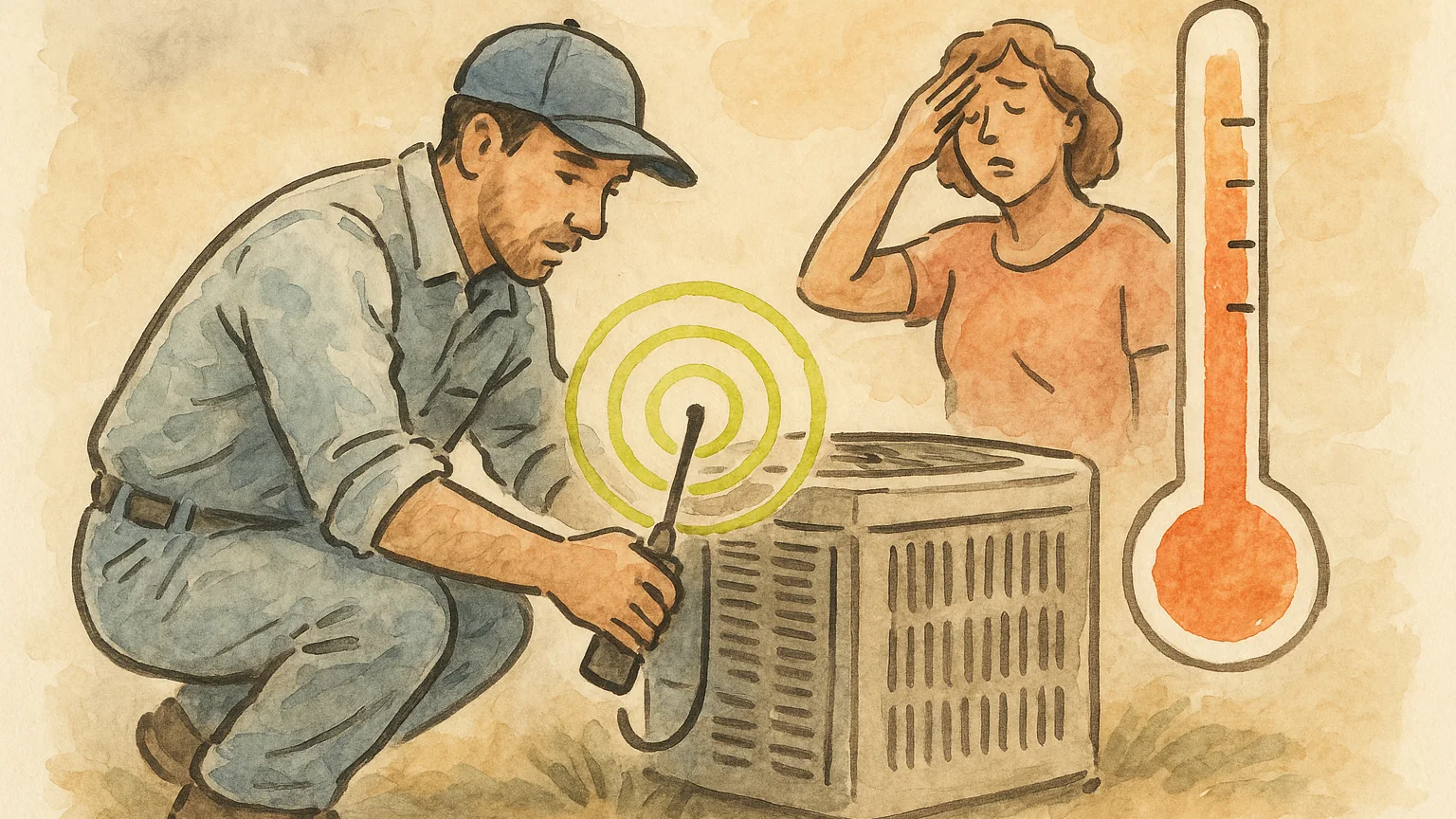
An hvac answering service earns its cost differently than coverage for most trades, because the number that decides the bill isn't one big emergency call, it's how sharply your call volume swings across the year. Volume sits flat for months, then jumps hard on the first sustained heat wave and again on the first hard freeze, and that shape is exactly what a flat-rate plan sized for an average month can't absorb. Overage charges kick in during the one stretch you actually need coverage working well. Not every after-hours call is a safety emergency either: a scheduled maintenance-contract callback and a no-cooling call from a vulnerable customer during a heat wave aren't the same call, and pricing them the same wastes money in one direction or the other.
What makes an HVAC answering service different from other after-hours coverage?
The vertical-specific story isn't the size of any one call, it's the shape of call volume over a year. A plumber's math turns on how big one emergency ticket is. HVAC's math turns on how far the worst week's volume exceeds what your plan assumes, because it's rarely close.
The general after-hours math works by multiplying a missed call by its value and comparing that to a monthly bill. That still applies here, but it undersells the actual risk for HVAC, because it assumes a roughly steady rate of calls. HVAC volume doesn't arrive steady. It arrives in a trickle for most of the year and a flood for two or three weeks, and a plan that was never priced for the flood is the plan you're stuck with when it hits.
How much does seasonal HVAC call volume actually swing?
By a wide margin, and predictably. Volume holds near a baseline through spring and fall, then jumps hard in the first stretch of real heat and again at the first hard freeze. A shop that plans a phone plan around an average month is planning around a month that barely exists.
You already know the pattern from your own board: quiet stretches followed by a run where the phone doesn't stop for a week. What matters for this decision is that the run is predictable in timing, if not in exact size, and a billing plan can be chosen with that run in mind instead of against the average month that surrounds it.
Why does a flat-rate plan turn into a trap during a heat wave or a freeze?
Because the ceiling is sized for your typical month, and the spike week isn't typical. Cross the ceiling and the plan either charges a steep per-call overage or bumps you to the next tier, either of which can cost more than a plan billed per call from the start.
Here's the arithmetic, worked through once with example numbers to plug your own quote into, not published rates. Say a vendor quotes the same coverage three ways: 70 cents a minute, $1.50 a call, or $130 flat for up to 100 calls a month with $3.50 per call after that.
| Month type | Calls | Avg. length | Per-minute bill | Per-call bill | Flat-rate bill |
|---|---|---|---|---|---|
| Shoulder (spring/fall) | 90 | 2.5 min | $158 | $135 | $130 |
| First heat wave (one bad week) | 320 | 3.5 min | $784 | $480 | $900 ($130 + 220 over × $3.50) |
| Steady summer plateau | 200 | 3 min | $420 | $300 | $480 ($130 + 100 over × $3.50) |
The flat-rate plan wins by a few dollars in a typical month and loses badly in the two kinds of month a seasonal HVAC business can't avoid. Per-call absorbs the swing in something close to a straight line, which is the property that actually matters here. Swap in your own quote's numbers, and count both the shoulder months and the one or two weeks a year when the phone genuinely doesn't stop, because that second number is the one a flat-rate plan is priced to survive only barely.
Is every after-hours HVAC call a safety emergency?
No, and treating them the same wastes money in both directions. A no-heat call from an elderly or medically fragile customer during a hard freeze is a genuine safety issue. A maintenance-contract callback to schedule a routine tune-up isn't urgent at all, and it can wait for morning without anyone at risk.
That split is what an HVAC answering service actually needs to get right, more than raw triage speed. It has to route the no-heat-in-a-freeze call like the emergency it is, and it has to let the maintenance-contract callback sit in a queue for a normal business-hours callback instead of paging anyone. A service priced and staffed for constant emergency triage is solving a problem that's only true for part of your call volume, and you're paying for the rest of it either way.
Don't buy this if…
Skip it if your shop already has a seasonal on-call rotation that reliably reaches someone, if most of your after-hours volume is scheduled maintenance rather than genuine no-heat or no-cooling calls, or if your service area rarely sees the kind of sustained heat or hard freeze that actually spikes volume.
Skip it too if you can't yet say, even roughly, how much your own volume swings between a quiet month and your worst week. The table above only tells you which billing model wins once you know your own numbers; guessing at the swing is how a shop ends up on the wrong plan for the exact weeks that matter.
Is "hvac after-hours answering service" the same search as "hvac answering service"?
Yes, close enough that the same page should answer both. It's the same vendors, the same billing models, the same seasonal-spike problem, with "after-hours" spelling out timing the base phrase leaves implicit. The arithmetic below doesn't change based on which phrase you typed to get here.
What's worth knowing before you shop: at least one of the vendor posts already ranking for this term claims to have run hundreds of its own test calls before naming a winner, and the winner it names is the vendor running the test. That's not a knock on the testing. It's a reason to read the arithmetic yourself rather than take anyone's ranking on faith, including this page's. If you want a second opinion on a specific quote, the contact page is there, but most shops that run their own numbers through the table above won't need one.
Sources
- Longer Heat Waves, Bigger HVAC Challenges — The ACHR News, 2026-08-13
- Tips to prevent frozen pipes, furnace failures during extreme weather — Cleveland 19 News, 2026-01-19
- When Summer HVAC Demand Spikes, After-Hours Calls Do Too — ServiceTitan, State of the Trades, 2026-06-03
- Heat and Older Adults (Aged 65+) — Centers for Disease Control and Prevention, 2024-06-25
- Preventing Hypothermia — Centers for Disease Control and Prevention, 2026-08-25
- Cold Weather Safety for Older Adults — National Institute on Aging, 2024-01-03
- Smith.ai Plans & Pricing for 24/7 Sales & Support — Smith.ai, accessed 2026-09-07
- AI Receptionist Pricing: 4 Plans from $24.95/mo | Aira — Aira, accessed 2026-09-07
- Affordable Answering Service — Specialty Answering Service, accessed 2026-09-07
- Best Answering Service for HVAC Companies: 8 Tools Tested (2026) — Retell AI, 2026-09-03