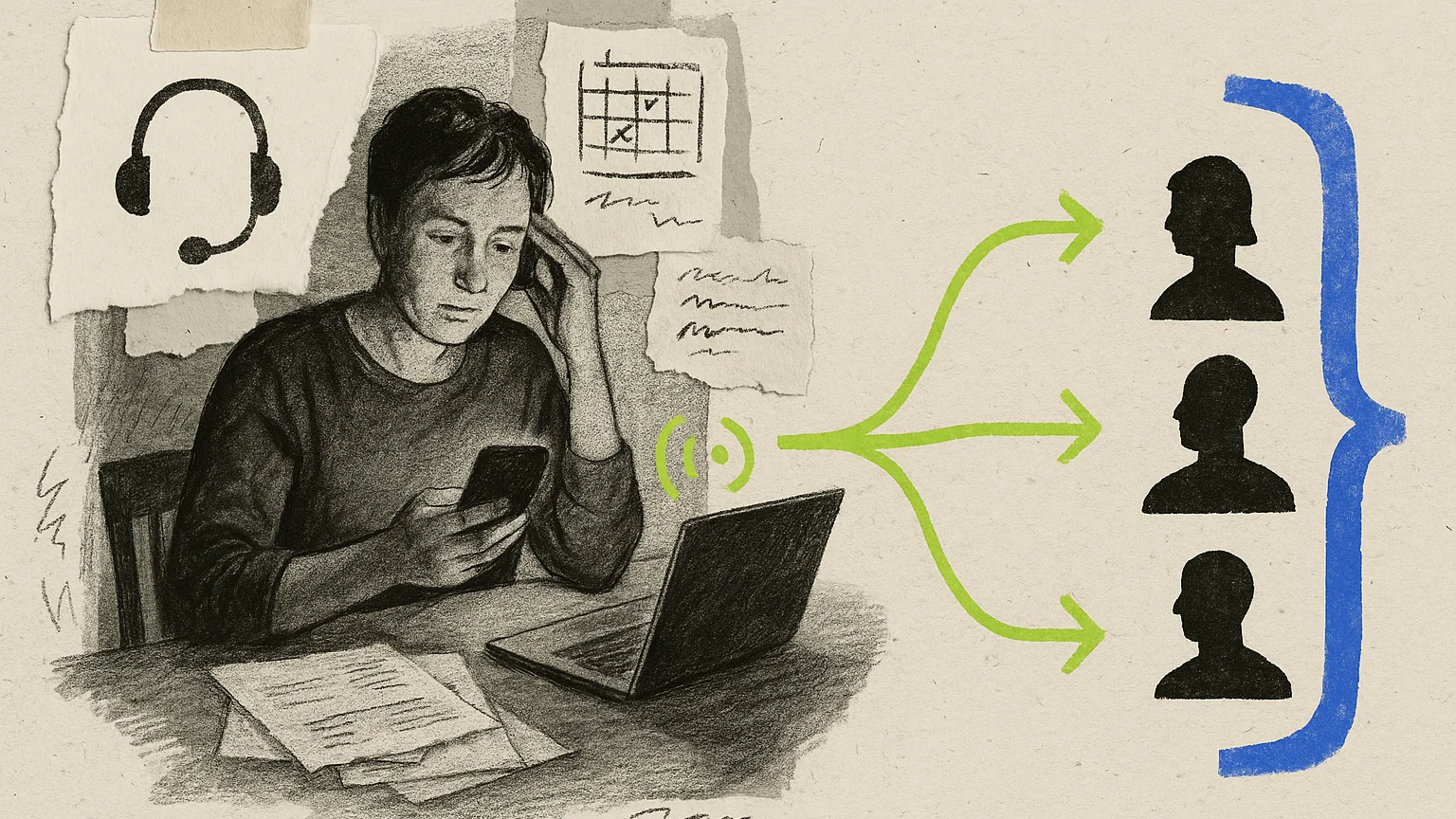
A remote receptionist is a live person, working off-site, who answers your calls the way someone at your front desk would: working from your calendar, rebooking appointments, and using judgment on a caller a script can't cover. That's the difference from a plain answering service, which mostly follows a fixed script and hands off anything outside it. A remote receptionist usually costs more than scripted coverage and less than a full-time hire, and the choice among the three comes down to one question: how much judgment do your calls need? Mostly routine bookings, a scripted service is enough. Calls that regularly need a real decision, a remote receptionist earns the difference. Calls that need one constantly, a part-time hire on-site starts to beat both.
What does a remote receptionist actually do?
Answers your calls the way someone at your own front desk would, just off-site: working from your calendar, booking and rebooking appointments, taking a message that actually captures what the caller needs. Unlike a scripted service, a remote receptionist can use judgment when a call doesn't match the script.
That's a meaningfully bigger job than call-taking. Rebooking a customer who wants to move Thursday's appointment to next Tuesday requires actually seeing your calendar and understanding what's movable. A caller who describes a problem your script never anticipated needs someone who can ask a follow-up question instead of reaching for the nearest category that sort-of fits. A remote receptionist is closer to a part-time employee who happens to work somewhere else than to a phone system with a person attached.
How is that different from an answering service?
An answering service mostly follows a fixed script: sort the call, take a message or book from a set of open slots, hand off anything it can't place. A remote receptionist can do more of what an in-house employee would do, and costs more accordingly. The gap between them is judgment, not friendliness.
Both can sound warm and professional on the phone. That's not where they diverge. An answering service is built to handle volume cheaply by keeping every call inside a small set of paths; the moment a call needs a decision outside those paths, it escalates to you or takes a message and stops there. A remote receptionist is built to handle the decision itself, within whatever limits you've given them, which is the entire reason the price is higher.
Laid out side by side, the three options split on the same two questions every time: how much of the decision is made without you, and how it's billed for that privilege.
| Scripted answering service | Remote receptionist | Part-time in-house hire | |
|---|---|---|---|
| Works from your actual calendar | No — books from open slots you configured in advance | Yes, directly | Yes, directly |
| Handles a call the script didn't anticipate | Escalates it to you or takes a message | Uses judgment within limits you've set | Uses judgment, knows the business firsthand |
| How it's billed | Per minute, per call, or a flat rate with a ceiling | By the hour or a block of hours | A wage, plus payroll tax and covering the person's absences |
| Where it breaks | Any call needing real judgment | A judgment call outside the limits you defined | Cost, once the volume needing judgment doesn't justify a full payroll line |
Where does a part-time in-house hire beat both?
Once enough of your calls need a decision only someone who knows your business well would make. Below that point, you're paying an off-site person or service to reach roughly the same conclusion you would. Above it, you're paying someone to escalate calls back to you anyway, which is where in-house starts to look cheaper.
Think about it as a ratio, not a threshold. If one call in twenty needs real judgment, both a remote receptionist and a scripted service can absorb that: the one occasional escalation is cheap either way. If it's closer to one call in three, an off-site person is now making a meaningful share of decisions about your business without sitting in it, and a scripted service is escalating constantly, which quietly turns "coverage" back into "you're still answering the phone, just with extra steps." That's the point a part-time person on-site, who knows your customers, your pricing, and your schedule without being told each time, starts to earn back the higher cost of employing someone directly.
How are the three actually billed?
Differently, and the billing shape tells you almost as much as the price. Answering services meter by the minute, the call, or a flat rate with a ceiling. Remote receptionists are typically billed by the hour or a block of hours. An in-house hire is a wage plus everything a wage brings with it.
That last part is easy to undercount. A wage is only the headline number. Payroll tax is the part you can look up. The rest you already know from running the business: the time it takes to train someone, and the phone that comes back to you when that one person is out sick or on vacation. A contracted remote receptionist or an answering service doesn't hand you those costs in the same way, because staffing the gaps is the vendor's problem, not yours. Compare the sticker prices of all three and you're comparing three different things: a metered utility, a block of contracted hours, and an employee.
Don't buy this if…
Skip the upgrade if a scripted answering service is already catching your calls without your customers noticing the difference. You don't need more judgment than the job requires. Skip a part-time hire, too, if your call volume needing real judgment is still small; you'd be paying full-time overhead for part-time need.
There's a cheaper middle step worth trying before either upgrade: ask your current provider, whatever it is, to flag every call it escalates to you for a month and look at what those calls actually needed. If most of them needed information you could have given the service in advance (an updated price list, a wider set of bookable slots, clearer instructions for common exceptions), you can close most of the gap by feeding the system you already have, not by buying a more expensive one.
You don't need to hire your way out of a problem that better instructions would fix.
Most owners reading this already have an answering service or nothing at all, not a remote receptionist, which is exactly why this is worth working through before signing up for either upgrade: the after-hours arithmetic is the same math one layer down, for the calls you're not even catching yet.
Sources
- Virtual Receptionists | Hire a Virtual Receptionist Today — MyOutDesk, accessed 2026-09-07
- Virtual Receptionists - Affordable 24/7 Phone & Chat Support | HelpSquad — HelpSquad, accessed 2026-09-07
- Healthcare Virtual Assistant Pricing | $9.50/hr | Hello Rache — Hello Rache, accessed 2026-09-07
- Pricing | PATLive — PATLive, accessed 2026-09-07
- Smith.ai Plans & Pricing for 24/7 Sales & Support — Smith.ai, accessed 2026-09-07
- Understanding employment taxes — Internal Revenue Service, 2026-05-01
- Employer Costs for Employee Compensation Summary — U.S. Bureau of Labor Statistics, 2026-06-12
- Pricing - MyOutDesk — MyOutDesk, accessed 2026-09-07