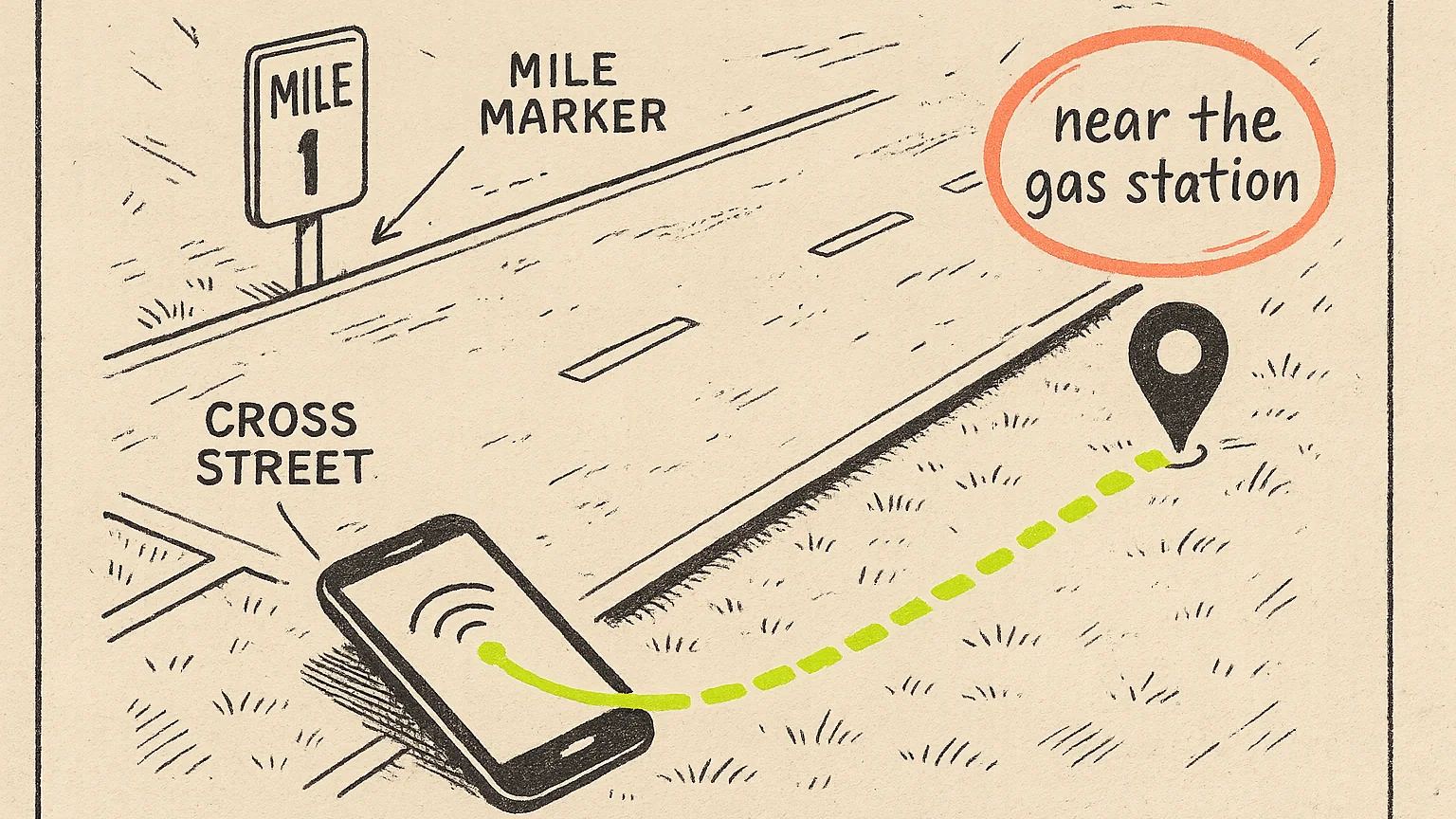
A towing answering service has to answer one question before anything else: where. Every trade on this site handles urgent calls, but a tow call is worth nothing until dispatch knows which shoulder, which mile marker, which cross street the vehicle is on, and the driver standing beside it does not always know. The intake has to draw a usable location out of a caller who may not have one, then route straight to a driver who can move, not to an office that takes a message and promises a callback. The category also carries a risk no other vertical here does: a towing call can be answered and then sold on to someone else's truck.
What makes a towing answering service different from the other emergency trades on this site?
It isn't urgency. Every trade on this site that answers a 2am call is already handling something urgent. It's that a tow call is worth nothing until dispatch knows where the vehicle is, and the caller does not always know. Plumbing and electrical triage on what's wrong. Towing triages on where, first.
The general after-hours math starts from what a missed call costs in lost revenue, and that's still the right frame for whether coverage is worth buying at all. But it assumes the call, once answered, is usable. A towing call that gets answered warmly and sympathetically but never pins down a location hasn't been served. It's been stalled with better manners than a busy signal.
What does a towing answering service intake actually need to nail down before anything else?
A location specific enough for a driver to drive straight to it: a mile marker, a cross street, a direction of travel, or a location pin from the caller's own phone. Anything vaguer than that isn't an intake yet. It's a caller who needs one more question before the call is dispatchable at all.
Most calls sort quickly once the caller has anything concrete to give. A few don't, and those are exactly the ones the intake has to be built for.
| What the caller says | Dispatchable? | What has to happen next |
|---|---|---|
| A highway number and mile marker | Yes | Dispatch immediately, confirm direction of travel |
| A location pin shared from the caller's phone | Yes | Dispatch immediately, confirm side of road |
| "I'm on the highway near some kind of gas station" | No | One follow-up: last exit passed, or the sign on the gas station |
| "I don't really know, it's dark" | No | Walk the caller to a location share, or the nearest visible mile marker |
| Vehicle year, make and model, no location given | No | Get the location first. The vehicle details can wait |
That middle band is the one a script built for a calmer trade will miss. A caller who's rattled, standing on a shoulder with cars passing, doesn't always volunteer a mile marker unprompted. Whatever answers the line has to ask for it directly, every time, before it asks anything else.
Why does a towing answering service call have to reach a driver, not an office?
Because the next step after location isn't a callback. It's a truck moving. An intake that takes a message and promises someone will call back has handed a stranded driver a reason to dial the next number, and it's done nothing that gets a truck any closer to the shoulder.
That's a sharper version of a problem every emergency trade on this site shares, but towing has the least slack in it. A plumber's burst pipe keeps running for another twenty minutes either way. A driver on a live shoulder with traffic passing at speed doesn't have the same twenty minutes to spare, which is why the routing step (call answered, location confirmed, driver notified) has to happen without a human queue sitting in the middle of it.
What's the dispatch-reselling problem, and how do you tell if that's who's answering your line?
Not every line that answers a towing call sends it to the company the caller meant to reach. Towing is one of the trades where calls get intercepted and routed through lead-generation services and sold on, which means a line you pay for monthly can quietly stop being yours.
Nobody selling this arrangement describes it that way on the pricing page. It gets called "dispatch network," "overflow coverage," or "24/7 answering," and the difference only shows up when you ask the one question that matters: does every call answered on this number route to my trucks, always, or can it go to someone else's. A service confident in its own coverage can answer that in one sentence. One that hedges, or answers with a description of "the network" instead, has told you what you needed to know before you signed anything.
Don't buy this if…
Skip it if your own dispatcher already answers directly around the clock and rarely misses a call. Most owners already know their own miss rate, and coverage priced for a problem you don't have isn't protecting you from much.
Skip it too if you can't get a straight, written answer to the dispatch-reselling question above. Coverage that might quietly hand your caller to a competitor isn't a smaller version of what you're paying for. It's a different arrangement wearing the same invoice, and no amount of politeness on the call makes up for a truck that was never yours showing up instead.
Sources
- What to Do When Your Vehicle Breaks Down — AAA, accessed 2026-09-14
- MUTCD 11th Edition, Chapters 2H–2N — Federal Highway Administration, accessed 2026-09-14
- Google finds 10,000 fake listings on Google Maps, sues alleged network of scammers — CBS News, 2025-03-19
- Google says a scam network made thousands of fake businesses on Google Maps to collect and sell user data — Business Insider, syndicated on Yahoo News, 2025-03-22