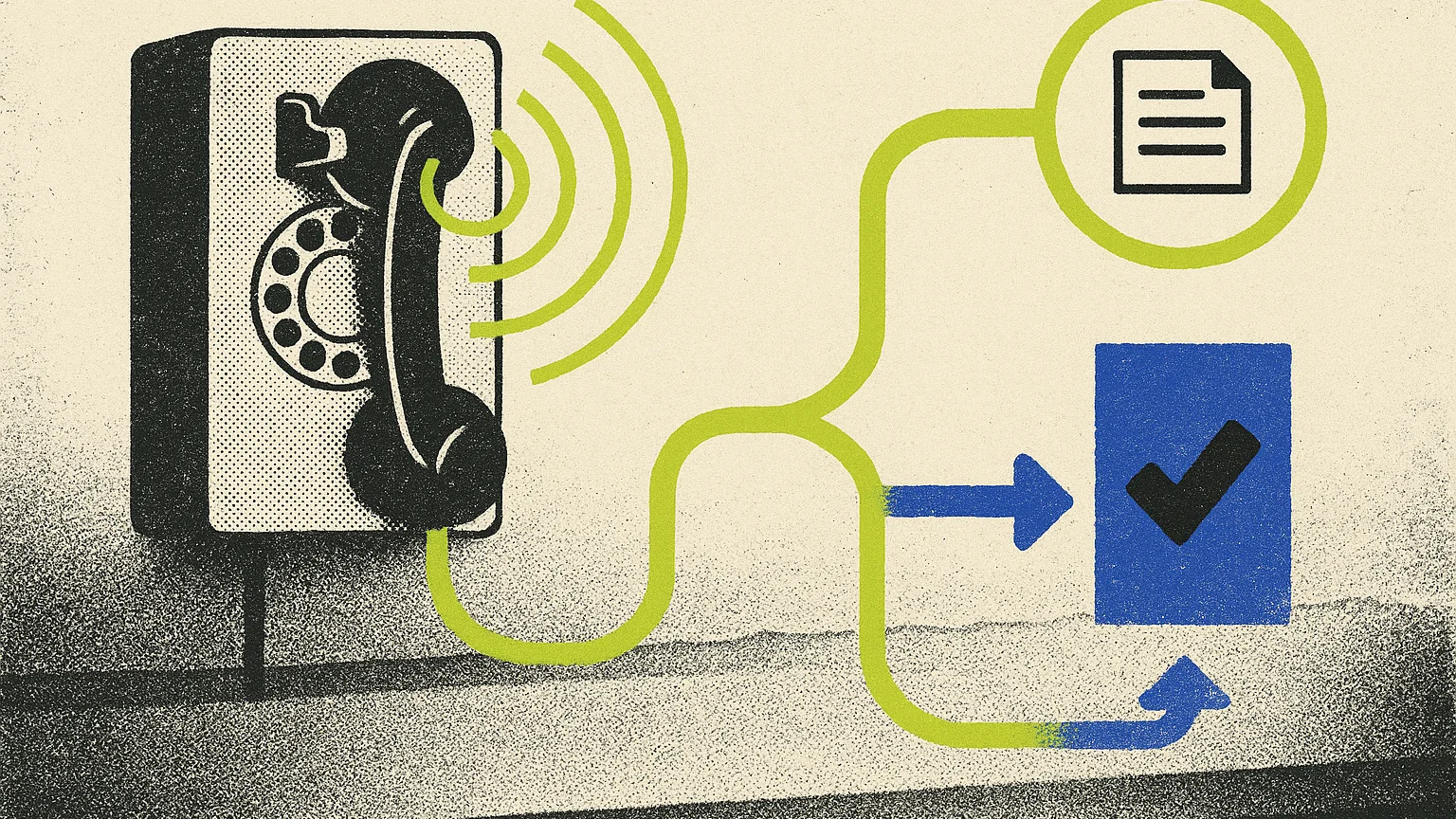
A professional voicemail greeting is the cheapest after-hours coverage a trade business already owns, and most of the templates ranking for the phrase were written for someone in an office, not a tech on a truck. The job isn't to sound polished. It's to sort the one caller who can't wait from everyone who can, inside the first ten seconds, and tell each one exactly what happens next. A caller with a real emergency needs a number, a page, or a text, not a cheerful request to leave a message and wait. Everyone else needs a callback window you'll actually keep. Three short greetings, recorded once, do that job: one for daytime overflow, one for after hours, one for a holiday closure that runs longer than a night.
What makes a professional voicemail greeting different for a trade business?
Most of the templates ranking for the phrase were written for someone at a desk who checks messages by lunch. A trade line's phone rings while somebody's got their hands inside a wall or a mile from signal. The greeting has to sort a call, not just sound polished.
A desk greeting only has to buy time: "I'm away from my desk, leave a message." Nobody on the other end is deciding whether to call the next business on their list in the next thirty seconds. On a trade line, some of the callers are. The same triage order a phone answering script runs on a live call applies here too, just compressed into a recording instead of a conversation: sort first, explain second.
What should the greeting say first?
The emergency line, before the business name or the hours. One sentence telling a caller with a real problem what to do right now, then the ordinary greeting. A caller who sits through ten seconds of hours and holiday closures before learning where an emergency goes has already decided you're not built for one.
That ordering feels backward if you're writing it like a normal greeting, name first, then everything else. It isn't backward on a trade line. The after-hours arithmetic on a missed call only works if the caller who's worth answering fast actually gets sorted fast, and a greeting that leads with your business hours instead of the emergency line is solving the wrong problem first.
Where does the emergency caller actually go?
A real destination, not a feeling. A number that's actually staffed, a page that reaches someone, or a text-back that fires the instant the call drops, if you already run one. "We'll get back to you as soon as possible" names no destination, so it sorts nothing.
Say the destination the same way you'd want it said to you. "If this can't wait, call or text this number" works only if a person is actually behind that number at 2am. If what you actually run is a missed-call text-back rather than a staffed line, say that instead: "text this number and we'll text you back" is an honest promise a vague one isn't. Naming a destination your greeting can't actually deliver is worse than naming none, because the caller stops looking elsewhere.
How long should it actually be?
Short. Most guidance on business greetings puts the useful range at 15 to 30 seconds, long enough to say the one thing that matters and short enough that an emergency caller doesn't hang up two lines in to try the next name on their list.
Everything past the emergency line and one callback promise is a greeting padding itself. Business hours, a second phone number, a slogan — none of it changes what the caller does next, and all of it delays the one line that does. Say the sort, say the destination, stop.
Here's the same decision as the artifact: three greetings, what each one has to say first, and how long it should actually run.
| Greeting | When it plays | What it says first | Where the emergency goes | Target length |
|---|---|---|---|---|
| Overflow (business hours, line's busy) | Daytime, lines full or someone's on another call | "If this is an emergency, press 1 or stay on the line" | Whoever's on call right now | 10–15 seconds |
| After hours | Outside your staffed hours | The emergency line, then a callback window for everything else | A number, a page, or a text-back you actually run | 15–25 seconds |
| Holiday closure | A closure longer than a single night | The emergency line first, then the specific day you're back | Same destination as the after-hours greeting | 20–30 seconds |
The after-hours and holiday greetings share a destination on purpose. The only thing that should change between them is how long the caller waits for a callback, because the closure is longer.
Do you need a different greeting for after hours and holidays?
Only if the answer to "what should they do right now" actually changes. A shop staffed later on weekdays than weekends needs its own after-hours version. A shop that closes the same way every night usually doesn't need a third script just for a holiday, unless the closure runs longer than a day.
Most phone systems let you schedule a different greeting for a date range without touching the main one, which is the only piece of this that's a setup task rather than a writing one. The writing stays the same three-part shape every time: emergency line, destination, callback window. What changes is how long you're honestly promising to take.
Don't buy this if…
Skip rewriting yours if you already answer live during business hours and your after-hours call volume is small enough to count on one hand a month. A perfectly sorted greeting doesn't fix a dead on-call line; it just tells the caller faster that nobody's picking up.
It's also not worth the exercise if every call on your line is genuinely the same kind of call. A greeting that sorts emergency from routine is only doing work where that split exists. If it doesn't, write one plain greeting and spend the quarter hour on something that moves the number.