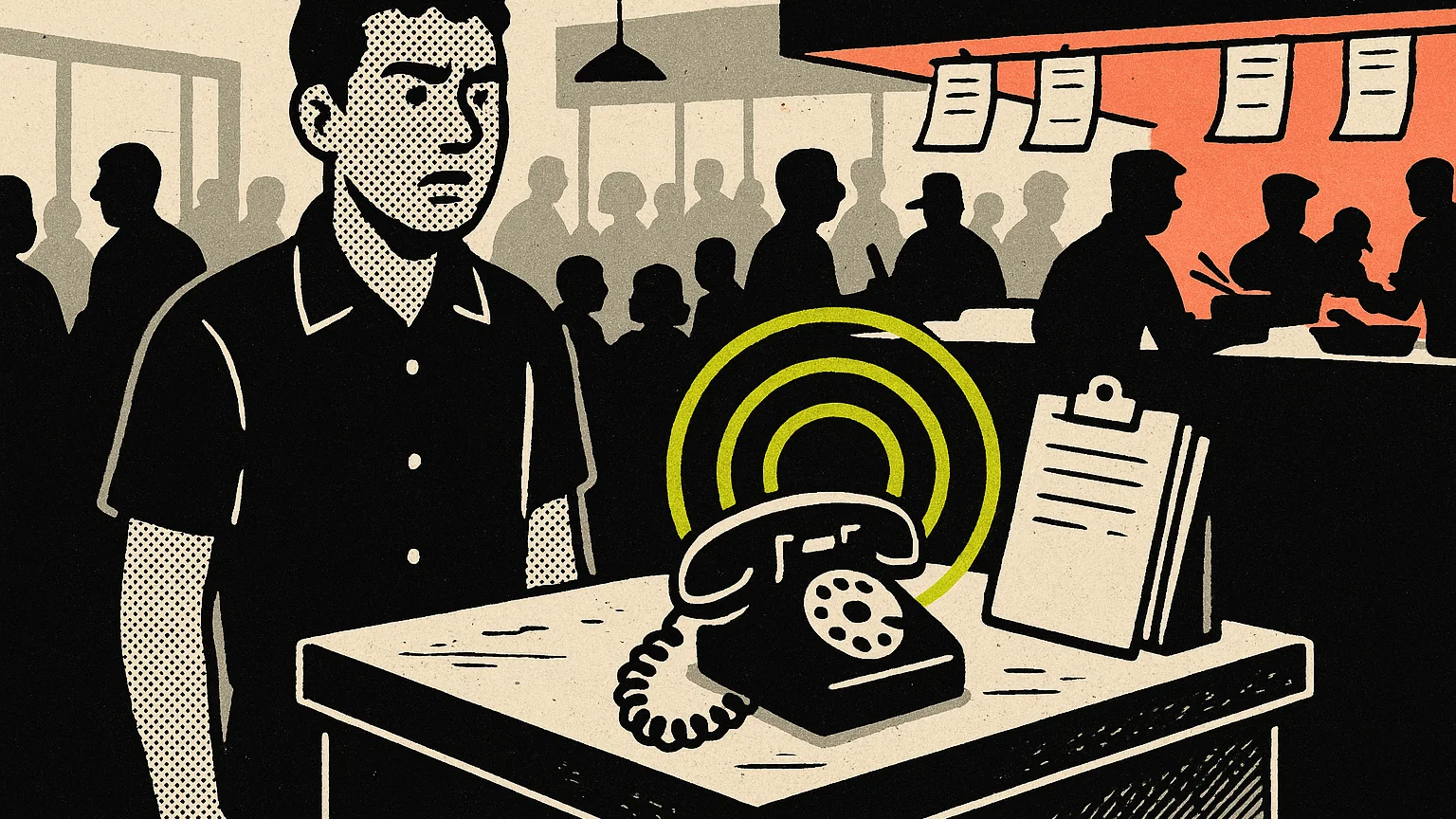
A restaurant answering service solves a different problem than most after-hours coverage. The gap it closes isn't nighttime, it's the two or three packed hours a service actually runs, when the phone rings the most and every person who could pick it up is already carrying plates, running the pass, or seating the door. Every call in that window is a reservation or an order with a dollar value attached to it right now, not a message that can wait for morning. What a restaurant answering service needs to get right is capturing that call correctly, the modifier, the pickup time, the party size, while the kitchen and floor keep running the rush the call interrupted. Miss it, and the caller doesn't leave a voicemail. They have every reason to call the next place.
What makes a restaurant answering service different from other after-hours coverage?
The vertical-specific story isn't nighttime. Reservation and order calls peak inside a few packed hours of service, when the phone rings most and the staff who'd normally answer it are already buried in the rush happening because of it. A plumber's after-hours line exists because the emergency happens at 2am; a restaurant's happens at 7pm on a Friday.
The general after-hours math assumes the missed window is nights and weekends, hours nobody's on the clock. A restaurant's missed-call problem happens during the busiest hours anyone is on the clock, which is a different failure than being closed, and it calls for a different fix: not someone to catch calls while the building is empty, but someone to catch the overflow while the building is completely full.
You already know this from any Friday night on the floor. The phone doesn't ring less during a rush. It rings the same as any other night, maybe more, because that's exactly when people are deciding where to eat. What changes is whether anyone has a free hand to reach it.
What does a restaurant answering service actually need to get right?
Order accuracy and overflow capture, not triage. A call has to land correctly: the right modifier, a pickup time the kitchen can actually hit, a party size the host stand can actually seat, not just a message taken and handed off after the fact. Get the menu wrong once and the order is wrong before it's even fired.
That's a narrower job than sorting an emergency from a routine call, and a harder one on the details. There's no burst pipe to spot here, but there is a caller asking for a substitution the kitchen doesn't do, a to-go order with three modifiers, or a party of eight wanting a time slot the room can't actually turn. A generic script built for message-taking has nothing to check any of that against. It writes down what it heard and moves on. You already know how that ticket turns out.
Getting the handoff right means whatever answers the phone can see the same menu, the same pickup window, and the same table math the floor is already working from. A perfectly polite call that books a table the dining room doesn't have, or takes an order the kitchen can't make as described, didn't actually help.
What does it cost when a rush-hour call gets missed?
Not a lost relationship most of the time. It's a lost ticket tonight. A caller who can't get through to book a table or place a to-go order is deciding where to eat tonight, not next week, and you already know what that caller does with a phone nobody picks up during a rush. They don't wait for a callback. They try the next place.
Here's the arithmetic, worked through once with example numbers to swap for your own, not a published rate. Multiply the rush-hour calls you miss in a week by your average ticket, then by the weeks in a month:
| Missed rush calls/week | Avg. ticket value | Weeks/month | Revenue at risk/month |
|---|---|---|---|
| 5 | $35 | 4 | $700 |
| 10 | $35 | 4 | $1,400 |
| 8 | $60 | 4 | $1,920 |
| 15 | $60 | 4 | $3,600 |
The ticket-value column is doing the real work, not the call count. A missed to-go order and a missed four-top reservation cost the same phone call. What they trigger doesn't. Run your own average ticket and your own missed-call count through this before you compare it to what coverage costs, because that number is the one no vendor's pricing page can hand you.
Where's the break-even for a restaurant?
It scales with how many nights a week you actually run a rush, not with total call volume. A single-seating spot with one busy Friday clears a different number than a four-turn Saturday house, so the honest math starts from your own average ticket and rush nights, not an industry rate.
That also means the break-even moves with your calendar, not just your growth. A service that wasn't worth it during a slow winter can clear its cost easily once a patio opens back up and Friday and Saturday both run a full rush. Recheck the arithmetic by season instead of assuming last quarter's answer still holds.
Don't buy this if…
Skip it if your rush-hour calls are mostly small parties willing to wait on hold, if a reservation platform already absorbs most of your booking volume without a phone call, or if your dining room runs light enough that a missed call during the rush is genuinely rare.
Skip it too if most of what comes in by phone is simple enough that anyone answering, staff or machine, would take it the same way, a table for two, no modifiers, no pickup window to hit exactly. The table above only earns its keep once a missed call has a real chance of costing a ticket that would have mattered, and plenty of smaller rooms never build up enough call volume for that to be true.
If you're not sure which kind you run, track two weeks of missed calls during service and sort them into "would have booked or ordered" and "wouldn't have." That's the honest input the table above needs, and it's worth having before any vendor quotes you a monthly rate.
Is a restaurant answering service the same as a construction answering service?
No, even though both pages argue the real problem isn't after-hours. Construction's problem is reachability: the person who'd answer is on a ladder all day with the phone out of reach. A restaurant's problem is capacity: the person who'd answer is right there on the floor, just already at capacity running the rush the call arrived during.
The construction page is the right read if your missed calls are mostly coordination that could happen anytime during a normal workday but doesn't, because nobody's hands are ever free. This page is the right read if your missed calls cluster hard into a few hours a night and disappear outside them. Most owners will recognize which shape their own calls take from the first paragraph. If you want a second opinion on a specific quote, the contact page is there, but most rooms that have sorted their own rush from their slow hours won't need one.
Sources
- The State of Restaurant Phone Communication: Insights from 1 Million+ Calls — Maple, 2025-12-07